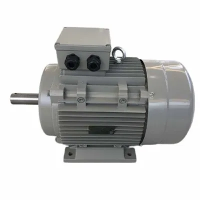
Durability Testing in 3-Phase Motor Manufacturing
Jul 03, 2025
Industry reports show that unexpected downtime caused by critical motor failures causes an average loss of tens of thousands of yuan per hour, not to mention the far-reaching impact on production plans and customer trust.
So, how to ensure that three-phase asynchronous motors can beat stably and persistently in harsh environments such as high temperature, high humidity, continuous vibration, and voltage fluctuations? The answer lies in the manufacturer's almost rigorous persistence in durability testing. This is not a simple "it works", but an extreme challenge that simulates the entire life cycle of the equipment:
1.High-temperature endurance race: The motor is placed in a temperature chamber far exceeding normal operating conditions (e.g. 55℃ or even higher) and continuously runs at full load for hundreds or even thousands of hours. The goal? Ensure that the temperature rise of the winding is strictly controlled within the safety limit (e.g. below 70℃) to prevent premature aging and failure of the insulation. Our laboratory data shows that after 1,000 hours of continuous testing at 55℃, the temperature rise of the motor with optimized heat dissipation design is still 15% lower than the national standard limit, and the life expectancy is increased by 30%.
2.Vibration and shock battlefield: Imagine the equipment is transported long distances on gravel roads, or works all year round next to machinery with severe vibrations. Our test bench accurately simulates these scenarios and applies multi-dimensional vibration and shock to the motor. Key indicators: All fasteners are not loose, bearings run smoothly without abnormal noise, and the internal structure is intact. According to statistics, the early failure rate of motors that have been screened by rigorous vibration tests on vibration-sensitive equipment (such as precision machine tools) has dropped by up to 40%.
3.Overload "stress test": Instant voltage surge or mechanical jam? The motor must be able to withstand it! During the test, we simulated short-term large overloads (such as 150%-200% of the rated load) to ensure that the motor can provide enough torque to get out of trouble and trigger an effective protection mechanism to avoid burning. This is directly related to the safety of equipment and personnel.
4.Persistence in humid environments: Whether it is salt spray in coastal factories or steam in papermaking workshops, moisture is the enemy of insulation. We conduct rigorous moisture and dust (IP level) tests and long-term wet and hot alternating tests to ensure that the insulation resistance is always high and eliminate the risk of creepage and short circuit. The report of Intertek, an authoritative testing agency, pointed out that about 18% of motor failures are directly related to erosion in humid environments.
5."Accelerated life" test: We don't want to wait ten years to know the results. Through scientific acceleration methods (such as increasing temperature, voltage, and load cycle frequency), the aging process of the motor running for many years is simulated in a relatively short period of time (such as a few months), and its life and potential weaknesses are accurately predicted. This allows us to optimize the design before the product is launched to ensure that it reaches or even exceeds the promised 100,000 hours of service life in actual applications.